
For New Zealanders in the Greater Bay Area

Jiangmen city guide 江门

On the western side of the Pearl River Delta, Jiangmen's villages tell a story of migration, including to New Zealand. Families sent money home to build Kaiping's fortified diaolou towers and the arcaded market at Meijia Dayuan in Taishan. In nearby Shuikou, a manufacturing town in Kaiping, local factories make taps and bathroom fittings.

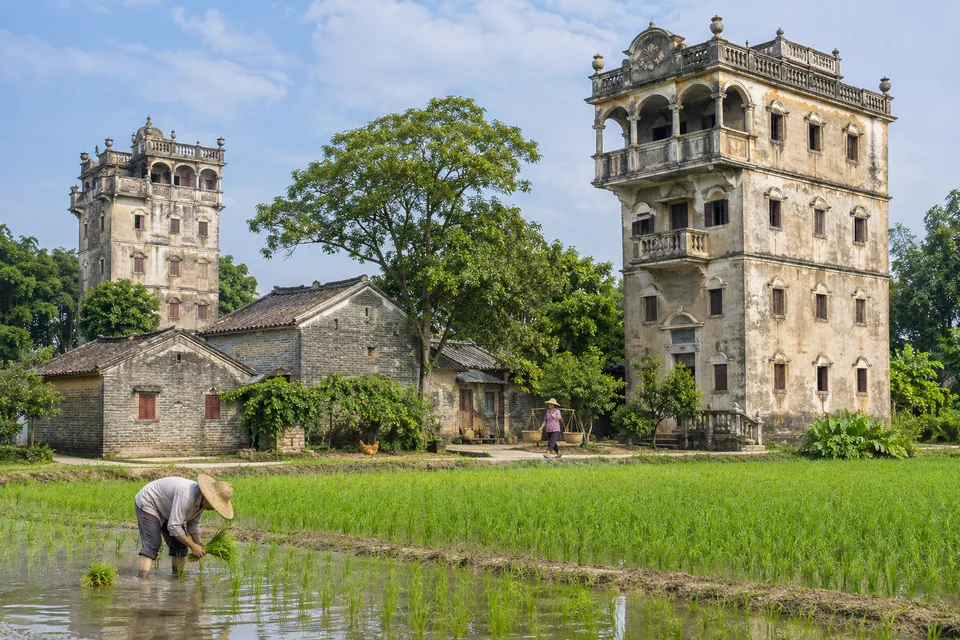
Kaiping diaolou watchtowers beside rice fields in Jiangmen

Arriving and getting around

Jiangmen railway station is in Xinhui. Jiangmen East is a separate station in Jianghai, at the junction of Wuyi Road and Donghai Road. China Railway publishes train services, and Zhuhai Airport's operator lists Jiangmen coach connections. Kaiping, Taishan, Heshan and Enping have their own local centres beyond central Jiangmen.

Local services and official contacts

Jiangmen in the Greater Bay Area

Jiangmen sits on the western side of the Pearl River Delta. It covers Pengjiang, Jianghai and Xinhui districts and four county-level cities: Kaiping, Taishan, Heshan and Enping. Wuyi, meaning 'five counties', is the historic regional name you will encounter in museums and family histories.

Explore the main areas · 9 cities and 2 SARs

View the city in the regional map
The eleven GBA cities and SARs around the Pearl River estuary North-up orientation map. Guangzhou and Foshan are inland to the north. Dongguan, Shenzhen and Hong Kong are on the eastern side of the Pearl River estuary, with Huizhou farther east. Zhongshan, Zhuhai and Macao are on the western side; Jiangmen and Zhaoqing are farther inland. Markers indicate central locations, not municipal boundaries. Select a city for its guide. Zhaoqing Guangzhou Foshan Dongguan Huizhou Shenzhen Hong Kong SAR Zhongshan Jiangmen Zhuhai Macao SAR
City-centre locations, not municipal boundaries. On smaller screens, swipe or scroll across the map. Coastline: Natural Earth, public domain.

Living & visiting

Get to know Jiangmen and Wuyi

Pengjiang trading streets, Xinhui's chenpi or the fortified towers of Kaiping

Pengjiang: trading streets and migration history

Changdi and Xuding are part of the old commercial city. Their arcaded shopfronts combine Chinese relief decoration with Western columns; food shops and cafés now share the streets. The Jiangmen Wuyi Overseas Chinese Museum is also in Pengjiang, at Wuyi Overseas Chinese Square.

Xinhui: chenpi and Liang Qichao

Xinhui is known for chenpi, dried and aged citrus peel, and as the birthplace of Liang Qichao. Born in Chakeng village in 1873, Liang took reform ideas abroad after the failed 1898 reform movement, publishing Chinese-language newspapers and founding schools for overseas Chinese. His former home and nearby Guifeng Mountain offer cultural and outdoor stops in the district.

Kaiping and Taishan: arcaded trading streets

Chikan in Kaiping has a large ensemble of arcaded buildings, while Taicheng, Taishan's urban centre, has its own historic shopping streets. Their shop-houses provide a contrast to the rural tower villages and the purpose-built market square at Duanfen.

Places and local culture

A connection with Chinese New Zealand history

Siyi means the four historic counties of Xinhui, Taishan, Kaiping and Enping, now within Jiangmen. Te Ara records Siyi among the home regions of early Chinese migrants to New Zealand, alongside Panyu, Zengcheng, Dongguan and Zhongshan. For families with roots here, the villages belong to a New Zealand story too; Guangzhou's Panyu and Zengcheng connect other families to the region.

Kaiping diaolou: why village homes became towers

Kaiping's diaolou were built as shared refuges, fortified family homes and watchtowers. Money sent home by migrants paid for construction, and returning emigrants brought architectural ideas from abroad. The UNESCO World Heritage property, inscribed in 2007, covers four groups of sites. For a heritage or planning exchange, select a village from UNESCO's maps and ask the site manager and residents how tower repairs, access to homes and protection of the surrounding farmland are handled there.

Meijia Dayuan: overseas money built a market

In Duanfen, Taishan, overseas Chinese and their families established Meijia Dayuan in 1931. Its 108 arcaded buildings form a rectangle around an open trading space. The individual façades mix Chinese and overseas influences: migration financed a place for everyday commerce as well as the better-known fortified towers.

Want to connect with Kiwis in Jiangmen?

For New Zealand community and WeChat introductions, tell NZGBA your city, a little about yourself and whether you live locally or are visiting. Introductions depend on available contacts and group administrator approval.

Business & industry

Visiting for business

Bathroom fittings, appliances and vehicle components

Find the town that makes your product

Pengjiang has motorcycle and component manufacturers; Taishan has automotive-parts businesses. The municipal industry list also places stainless steel in Xinhui, engineering equipment in Heshan and electronics in Jianghai. Use that list to narrow a search for a particular product before arranging meetings across Jiangmen.

Shuikou: taps, valves and bathroom hardware

Shuikou in Kaiping has made taps since 1958. A specialist factory opened in 1965, and firms such as Huayi are part of a local industry that makes and tests taps, valves and their parts. Buying for a New Zealand drinking-water project? If your design follows G12/AS1, the Building Code's Acceptable Solution for water supplies, get the tap's exact model and finish. Ask for the material specifications and the lead-content report for copper-alloy parts that touch the water. Check that the report covers the tap you're being quoted.

Appliances and their components

Pengjiang makes televisions, air conditioners, fans, rice cookers, coffee machines and bread makers, with production in Tangxia and Pengjiang Industrial Park. Suppliers also make motors, metal parts and packaging.

Industry information and sources

Industries and business clusters

Compare industries across the GBA
City facts and local background

Population: 4.829 million (end of 2025)

Area: 9,535 km²

2025 GDP: RMB 429.391 billion (about NZ$102.9 billion)

NZD conversion uses the same-year SAFE annual average.

Districts and local areas

Three urban districts

  • Pengjiang · 蓬江区
  • Jianghai · 江海区
  • Xinhui · 新会区

Four county-level cities

  • Taishan · 台山市
  • Kaiping · 开平市
  • Heshan · 鹤山市
  • Enping · 恩平市
References